Dreqalixana
Flux Bundle
Flux Bundle
Couldn't load pickup availability
- 🔄 Digital file available after purchase
- 🗂️ Long-term availability
- 🔐 Secure checkout
- 🗓️ Content updated in 2026
Self-paced learning overview
Problem Statement
A component library may contain well-organized buttons, fields, cards, and labels, yet full interface sections can still appear inconsistent. Components may be combined with different spacing, arranged in unrelated orders, or used without clear guidance for content hierarchy.
When repeated interface arrangements are not documented as patterns, designers may rebuild similar sections from the beginning. This can introduce unnecessary variation across forms, navigation areas, content displays, and page layouts.
Solution
Flux Bundle introduces a structured approach to building reusable interface patterns from established foundations and components.
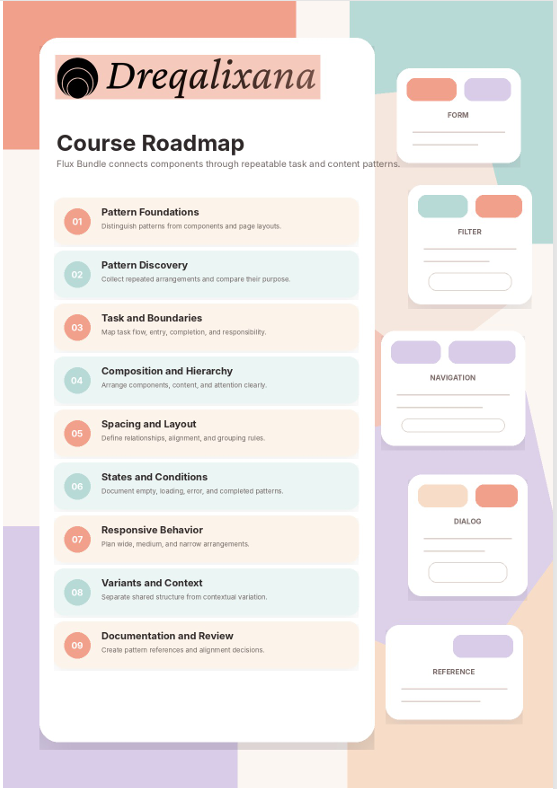
Learners examine the purpose of each pattern, identify the components it requires, define layout relationships, and record guidance for different content situations. The course also explains how patterns can remain flexible without losing their shared structure.
What’s Inside
The course includes lessons on pattern anatomy, component composition, content hierarchy, spacing relationships, layout groups, responsive planning, pattern states, and usage documentation.
Practical activities cover form groups, search areas, filter panels, notification sections, navigation structures, card collections, dialogs, empty states, and structured content sections.
Learners compare similar patterns, identify shared elements, review unnecessary duplication, and document where each arrangement should be used. The materials also explore how patterns respond to longer content, smaller spaces, missing information, and different interaction states.
Who Is This For?
Flux Bundle is intended for learners who understand visual foundations and component structure and want to study how reusable elements form larger interface arrangements.
It is suitable for interface designers, students, design system contributors, and team members involved in planning repeated layouts or reviewing consistency across multiple pages.
What You’ll Learn
- Distinguish components from interface patterns
- Identify the purpose of a repeated layout
- Combine reusable components into structured groups
- Define spacing relationships between elements
- Organize content according to hierarchy
- Plan patterns for different content lengths
- Document responsive layout behavior
- Create guidance for form and navigation patterns
- Define empty, loading, error, and completed states
- Compare similar patterns and reduce duplication
- Record component dependencies
- Describe when a pattern should or should not be used
- Review repeated page sections for consistency
30-Day Refund Terms
A refund request may be submitted within 30 days of enrollment. Requests are reviewed according to the refund conditions presented when the course is selected.
Certification
The course includes a certificate of completion, giving learners a clear way to confirm their progress and document the completion of Flux Bundle.
Share
Do I need previous design systems knowledge?
Do I need previous design systems knowledge?
No previous design systems knowledge is required for the opening tiers. Each course follows a structured sequence, beginning with foundational ideas and gradually introducing more detailed methods. Learners may begin with the tier that matches their current knowledge, although following the full order provides a more connected learning experience.
How are the course tiers connected?
How are the course tiers connected?
The tiers are arranged as one progressive learning route. Earlier courses introduce visual foundations, component thinking, naming, organization, and documentation. Later tiers build on these subjects through broader system planning, collaboration methods, maintenance routines, and detailed design decisions.
What learning materials are included?
What learning materials are included?
Each tier may contain written lessons, practical activities, planning exercises, reference pages, examples, review questions, and structured project tasks. The exact material depends on the focus and level of the selected course.